How Accounting Teams Can Reduce January 1099 Filing Rework
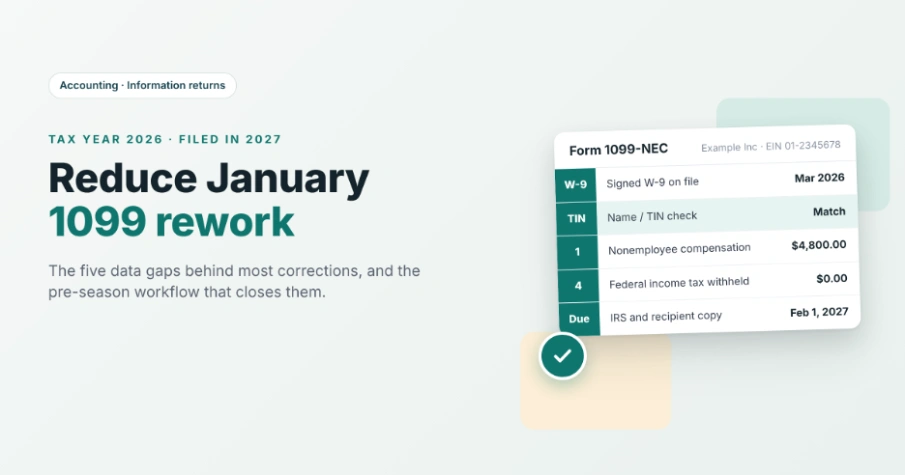
January 1099 rework is the second pass: the corrections, re-sends and rejections an accounting team works through after the first batch of Forms 1099 has gone out. Nearly all of it traces back to five data gaps that exist in October and are only discovered in January, when there is no time left to close them properly. This article explains what each gap is, what it costs under the 2027 penalty amounts, and a five-step pre-season workflow that removes most of the second pass before the first form is filed.
In this article
- What is 1099 rework, and what does it cost?
- Where January rework comes from: the five data gaps
- What is different for tax year 2026 returns filed in 2027
- A five-step pre-season workflow
- Handling the rework that still happens
- The pre-season checklist
- Frequently asked questions
- Sources
What is 1099 rework, and what does it cost?
Rework is any work done on a 1099 after it was supposed to be finished: a corrected return because the amount was wrong, a re-issued recipient copy because the address bounced, a vendor chased in January for a W-9 that should have been collected in March, a rejected batch re-keyed because the name on the form did not match the taxpayer identification number the IRS holds. None of it is new work. It is the same form, done twice.
The first cost is time, and January is the month a tax practice has the least of it. The second cost is set by the IRS. For returns required to be filed in 2027, the penalty for a late or incorrect information return is $340 per form under section 6721, plus a further $340 under section 6722 if the payee statement was also wrong. Fixing the form within 30 days of the due date cuts each amount to $60; fixing it by August 1 cuts it to $130. Intentional disregard starts at $690 per form with no annual cap. The chart below puts those together per form.
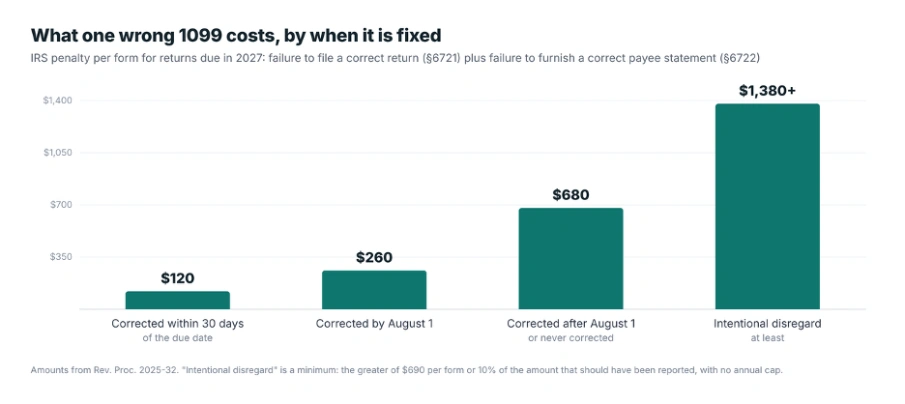
Figure 1. Combined section 6721 and 6722 penalties per form, for returns due in 2027, by when the error is corrected. Source: IRS Revenue Procedure 2025-32.
The lesson of the chart is not that penalties are large. It is that the price of the same mistake rises with every month it goes unfixed, which is exactly why rework discovered in January is cheaper than rework discovered in a CP2100 notice the following autumn, and why rework avoided in November is cheapest of all.
Where January rework comes from: the five data gaps
Ask a preparer which forms came back wrong last year and the answers cluster. The table below lists the five gaps that account for most corrections, how each one shows up in January, and the check that closes it before year-end.
|
The gap |
How it surfaces in January |
The pre-season check |
|
No W-9, or an unsigned one |
The vendor's legal name and TIN are unknown; the form is filed on guesswork or held back |
Make the W-9 a condition of the first payment; audit the vendor file in October |
|
Name and TIN do not match |
The IRS rejects the record, or a CP2100 notice arrives months later with a backup-withholding obligation |
Run the name/TIN combinations through the IRS TIN Matching program in November |
|
Wrong form, or the wrong box |
Rent on a 1099-NEC, attorney fees in the wrong box, a corporation that needed no form at all |
Map every general-ledger account to a form and box before December closes |
|
Amounts pulled from the wrong source |
Card and app payments double-reported, invoices counted instead of payments, two vendor records for one payee |
Reconcile the 1099 totals to the ledger by payment date, with card payments excluded |
|
Filing channel not ready |
A transmitter code that was never applied for, or a FIRE login that no longer works |
Confirm IRIS access, or the provider's, in November |
Gap 1: the missing or incomplete W-9
Form 1099-NEC needs four things from a payee: the legal name, the TIN, the federal tax classification and the address. The W-9 is the only document that supplies all four, and when the vendor signs it they certify under penalties of perjury that the TIN is correct. That certification is what lets the payer rely on the number. A vendor asked for a W-9 at the first invoice returns it in days, because they want to be paid. The same vendor asked in January, when the payment is a memory, returns it in weeks, if at all. The classification on the form also answers the first question a preparer has: payments to a C or S corporation are generally exempt from 1099 reporting, with exceptions such as attorneys' fees and medical payments, so a vendor who ticks the corporation box is usually one fewer form to prepare.
Gap 2: the name and TIN that do not match
A W-9 can be complete, signed and still wrong. The commonest case is a trade name on line 1 with an EIN that belongs to a different legal name, or a single-member LLC that gives the LLC's EIN when the IRS expects the owner's name and number. The form looks fine. The IRS record does not match it. The IRS TIN Matching program, available through e-Services to payers of reportable payments, lets a team check name and TIN combinations before a return is filed, and a mismatch found in November is a phone call. A mismatch listed on a CP2100 or CP2100A notice requires review under the IRS B-notice procedures and may require backup withholding at 24 percent. A B-notice does not, by itself, require a corrected information return.
Gap 3: the wrong form or the wrong box
For tax year 2026, the reporting threshold for nonemployee compensation on Form 1099-NEC and certain payment categories on Form 1099-MISC rose from $600 to $2,000. Other Form 1099-MISC categories retain separate thresholds, so teams must check the payment type before deciding whether a return is required. The higher threshold removes forms, but it does not remove the classification question. Nonemployee compensation goes on the NEC; rent, royalties, prizes, medical payments and gross proceeds paid to an attorney go on the MISC, each in its own box. A team working from a bank feed cannot see the difference; a team that has mapped each general-ledger account to a form and box can. A team preparing to file Form 1099-NEC for tax year 2026 should re-read the requirements before the mapping is set, including the new boxes and the February 1 deadline, because they changed.
Gap 4: amounts pulled from the wrong source
Three source errors produce most wrong amounts. The first is reporting what was invoiced rather than what was paid in the calendar year; Form 1099 reports payments, so a December invoice paid in January belongs to the next year. The second is including payment card transactions or qualifying third-party network transactions in Form 1099-NEC or 1099-MISC totals. These transactions fall under the Form 1099-K reporting rules and should be excluded from the payer’s NEC or MISC reporting, even when the settlement organization is not required to issue a Form 1099-K. Check how each payment was processed: using an app does not automatically make a transfer a qualifying third-party network transaction. The third is the duplicate vendor record: the same contractor set up twice, under a name and a DBA, so that neither record crosses the threshold although the payee did.
Gap 5: the filing channel
This is the gap with a hard date on it this year. The IRS FIRE system accepts its last information returns on November 19, 2026, and from January 1, 2027, IRIS, the Information Returns Intake System, is the only IRS channel for current-year, prior-year and corrected returns. A team that filed through FIRE in past seasons needs an IRIS transmitter control code of its own, or a filing provider that already holds one. The code is a separate application that takes time to process, so it is a November task, not a January one. The e-file requirement has not changed: a filer with 10 or more information returns of any type in aggregate must file them electronically.
What is different for tax year 2026 returns filed in 2027
- For 2026, nonemployee compensation generally becomes reportable at $2,000. On Form 1099-MISC, the $2,000 threshold applies to rents, prizes and awards, other income, medical and health care payments, and crop insurance proceeds. Royalties and substitute payments retain a $10 threshold; attorney gross proceeds and cash purchases of fish for resale retain a $600 threshold. Fishing boat proceeds and payments subject to backup withholding have no minimum reporting threshold.
- Form 1099-K. Third-party settlement organizations generally must report a payee’s third-party network transactions when gross payments exceed $20,000 and the number of transactions exceeds 200. Payment card transactions have no minimum reporting threshold.
- For tax year 2026, Form 1099-NEC is due to the IRS and recipients on February 1, 2027. Most Form 1099-MISC recipient statements and Form 1099-K recipient statements are also due February 1. Form 1099-MISC statements reporting amounts in Box 8 or Box 10 are due February 16, 2027. The electronic filing deadline for Forms 1099-MISC and 1099-K is March 31, 2027.
- FIRE closes on November 19, 2026. IRIS is the only IRS e-file system from January 1, 2027.
- $60, $130 and $340 per return by correction window, $690 or more for intentional disregard, each doubled where the payee statement was also wrong.
A five-step pre-season workflow
The workflow below is built around outputs rather than tasks. Each step ends with something the next step can rely on, which is what keeps the work from being redone.
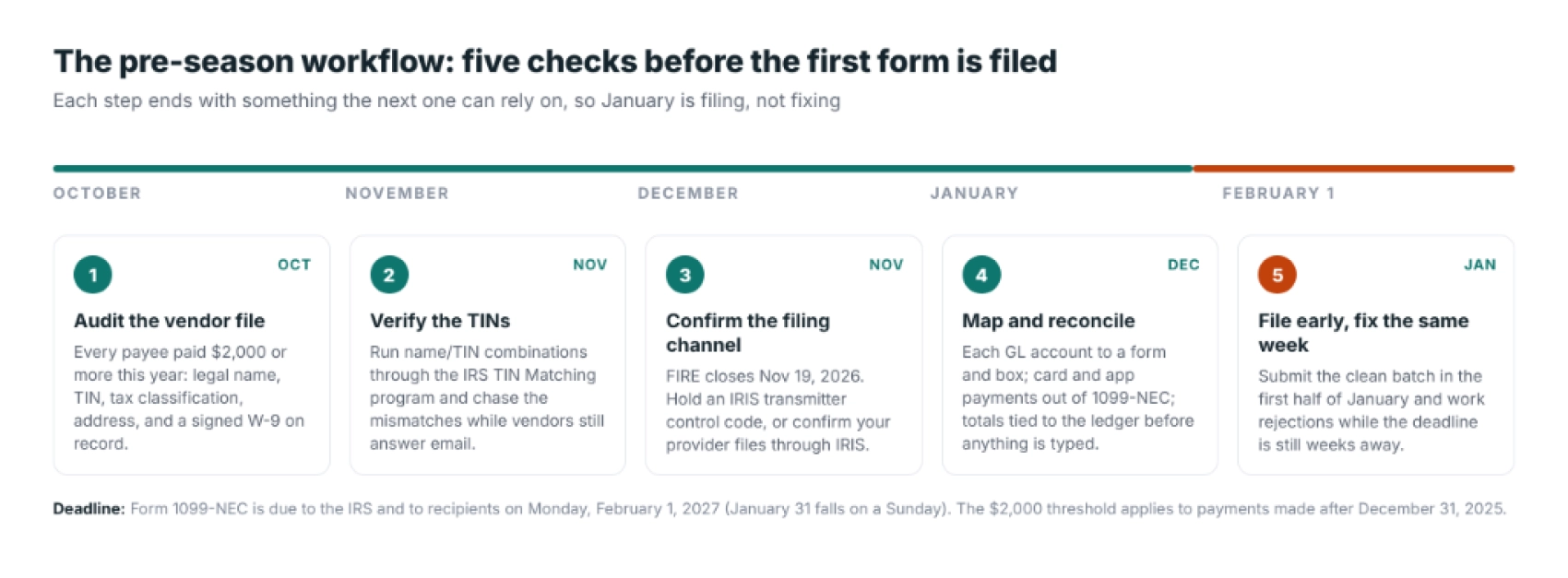
Figure 2. The five steps, placed on the calendar from October to the February 1, 2027 deadline.
- Audit the vendor file (October). Export every payee paid during the year, combine duplicate vendor records, and assess each payee against the reporting threshold and exceptions for the relevant payment category. For each, confirm a signed W-9 is on record and that the legal name, TIN, TIN type, classification and address are keyed into a vendor record rather than sitting in a PDF. Merge duplicate records. Mark the corporations that need no form, and the exceptions that do.
- Verify the TINs (November). Run the name and TIN combinations through the IRS TIN Matching program or have your filing provider run them. Investigate each mismatch promptly, checking for transcription errors and requesting updated Form W-9 information when needed. Apply backup withholding when the IRS rules require it; an unsuccessful pre-filing TIN match does not, by itself, establish a mid-December withholding deadline.
- Confirm the filing channel (November). Decide who transmits: the practice, under its own IRIS transmitter control code, or a provider under theirs. If the practice, apply now and test the login before December. If a provider, confirm in writing that they file through IRIS and how they return IRS acceptances and rejections to you.
- Map and reconcile (December). Map each general-ledger account to a form and box. Pull the year’s payments by payment date, exclude payment card and qualifying third-party network transactions from NEC and MISC totals, and reconcile the remaining reportable payments to the ledger.. Freeze the vendor file once the last December payment run has cleared.
- File early and fix the same week (January). File the clean batch in the first half of January. You can e-file through the free IRS Information Returns Intake System (IRIS) Taxpayer Portal or use an IRS-authorized e-file provider such as TaxFormHero. Review IRS acknowledgments as they arrive, resolve rejected submissions promptly and submit corrected returns when an accepted return contains an error. A form filed and accepted on January 12 is finished; a form filed on January 29 and rejected is rework with no room left.
Handling the rework that still happens
Keep a written procedure for rejected submissions, errors on accepted returns, and IRS notices. Resolve rejected submissions using the filing system’s instructions. Correct accepted returns using the applicable IRS correction procedures and furnish corrected recipient statements when required. For a CP2100 or CP2100A notice, compare the listed information with your records and follow Publication 1281, including the applicable first or second B-notice requirements and backup-withholding deadlines. Do not submit a corrected return solely because you received a B-notice. Keep records of TIN solicitations and update the vendor record so the issue does not repeat.
The pre-season checklist
- Vendor file exported, duplicate records combined, and each payee assessed against the applicable reporting threshold and exceptions
- Signed W-9 on record for each, with the data keyed into a vendor record
- Duplicate vendor records merged; exempt corporations marked
- Name and TIN combinations verified through IRS TIN Matching; mismatches chased
- IRIS transmitter control code held, or the provider's IRIS filing confirmed in writing
- Each general-ledger account mapped to a form and box
- Payment card and qualifying third-party network transactions excluded from 1099-NEC and 1099-MISC totals
- 1099 totals reconciled to the ledger by payment date; vendor file frozen
- Clean batch filed in the first half of January; rejections worked the same week
- Every correction written back to the vendor record
Frequently asked questions
What is the 1099-NEC reporting threshold for tax year 2026?
Generally, $2,000 in reportable nonemployee compensation paid to a payee during 2026. Payments subject to backup withholding must be reported regardless of amount. Form 1099-MISC has separate thresholds that depend on the payment category.
When are 2026 Forms 1099-NEC due?
Monday, February 1, 2027, to both the IRS and the recipient. The statutory date of January 31 falls on a Sunday in 2027, so the deadline moves to the next business day. There is no automatic extension for Form 1099-NEC.
Should payments made by credit card or PayPal be included on a 1099-NEC?
Exclude payment card transactions and qualifying third-party network transactions from Form 1099-NEC. Check the transaction type rather than relying on the app’s name: not every app transfer falls under the Form 1099-K rules.
Can I still file through the IRS FIRE system in 2027?
No. FIRE accepts its last filings on November 19, 2026. From January 1, 2027, IRIS is the only IRS system for e-filing information returns, including prior-year and corrected returns. Filers need an IRIS transmitter control code or a provider that holds one.
What is the penalty for filing a 1099 with the wrong TIN?
For returns required to be filed in 2027, $340 per return, plus $340 per payee statement if that was also wrong. The amounts fall to $60 if corrected within 30 days of the due date and $130 if corrected by August 1. Intentional disregard is at least $690 per form with no annual maximum.
How does the IRS TIN Matching program reduce rework?
It lets eligible payers check name and TIN combinations against IRS records before filing. Investigating mismatches early can reduce later notices and follow-up work. A mismatch alone does not automatically require a corrected return or backup withholding.
Do I have to e-file?
If you file 10 or more information returns of any type in a calendar year, counted together, yes. The threshold has applied since returns filed in 2024.
Disclaimer: This article is for informational purposes only and does not constitute tax or legal advice. The information is based on IRS website guidance available as of November 8, 2026. Tax rules and filing requirements may change. Consult the latest IRS guidance or a qualified tax professional for advice specific to your situation.